HAWGOOD FAMILY DNA STUDY
Click to go to Amazon

DNA study.

What is DNA testing.

What does it tell us.

How can I take part?.

Summary results.

Detailed results.

Mutation rates.

More on the maths.

Calculator.

Hawgood mutation rate.

More on Haplotype.

Mutation rate database.

Hawgood family Home.


Summary results

We are simply looking for values that match, and the number of mismatches is a guide, and a guide only, to the distance apart. We are also looking for same mutations occuring in more than one person, as this usually represents a new branch. It is possibly but very unlikely that the same mutation will occur by chance in unrelated branches, except with the very fast mutating markers such as DYS724a and DYS724b whose mutation rates are up to 10 times faster than the 'normal' mutation speed.

Looking at the detailed results, it can be seen that DYS19 is the same for all individuals, as are the next dozen or so. DYS449 is the first variation and this is seen in Ma and Mi who are known third cousins. We therefore know that this mutation occurred in 1842 or earlier, as this is their first common ancestor.

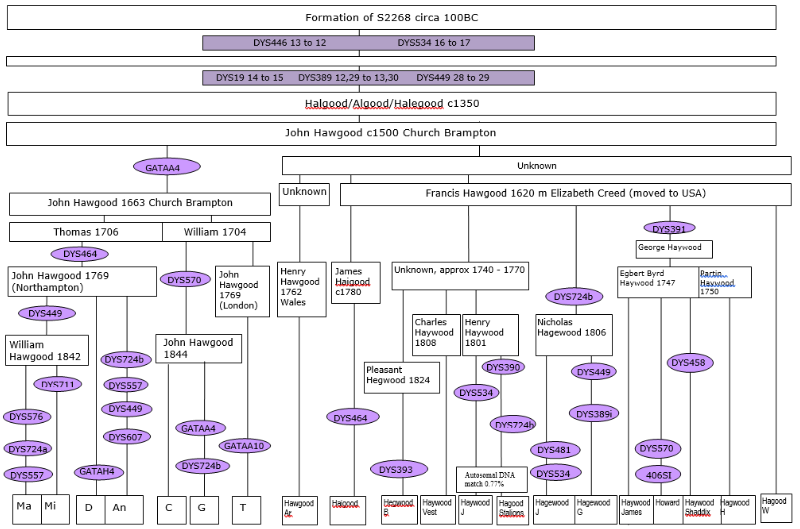
The most significant variation is on DYS464 which is a polymorphic marker with at least four  different values. The normal values for Hawgood DNA and indeed many of the same Haplotype (I1) are 12,14,15 and 16. However a mutation has occurred which is seen in four individuals which have different values, and within two of the four a slight variation there as well. This shows that there are in fact two distinct branches and we can conclude that these branches are from two of the sons of John Hawgood born 1663.

C and G from the 12,14,15,16 group, and descended from William Hawgood born 1704. T and Ar are also likely to be from this line, but it is not certain yet their common ancestor is after or before 1704. The likely hood is that it is not earlier than 1704 as the number of mutations is too small. D and 'An' are descended from Thomas born 1706, and the uniqueness of the mutations on DYS464 means we can be confident that Ma and Mi are also descended from Thomas.

This diagram shows where and which mutations occurred (purple ovals). The pink boxes show the number of generations between various ancestors. The dotted lines show links derived from the DNA results, with the unbroken lines showing known links. The test results have enabled us to connect three broken branches into the main family tree.


Generation gaps - actual versus predicted

We have compared the results of seven participants. The actual number of marker differences are shown in the first set of tables, which are used to predict the expected generation gap in the second tables. Finally, the actual generation gap where known is shown.   


Between M and M2, there is 1 mutation in 44 markers. The predicted generation gap is 3-6 generation, and the known gap is 3 generations. The theory matches the known difference. With the 67 marker test however there are 3 additional mutations which predict a gap of 7-8 generations, which is longer than the known difference of 3 generations. This increased variance is more likely to occur where a number of faster mutating markers are included in tests, such as the additional 23 markers in the 67 marker test compared to the 44 marker test, and it